
The optometric examination to fit assistive devices for low vision is performed by an expert optometrist with experience in fitting assistive devices for low vision.
At the beginning of the examination, the general and ocular history of the disease affecting the eye and its characteristics are examined, as well as the stage of the disease and the medical treatments performed, if any. During the conversation, the patient is asked to describe the daily difficulty caused by the vision problem.
The test is different from a regular test and is performed at a distance of 2 meters (rather than the standard distance of 6 meters) in order to allow identification of digits that are sometimes not possible at a greater distance due to low visual acuity.
The test is conducted using a board adapted for testing poor visual acuity and a board for testing peripheral vision that allows for the identification of areas on the retina that allow for better, higher-quality vision.
After the standard optometric examination phase and with the help of a special examination set that includes telescopic lenses, microscopic lenses, and filters of different wavelengths, the optometrist looks for auxiliary devices that will alleviate the individual difficulty that the patient presented at the beginning of the examination.

Many people with eye diseases suffer from vision problems that cannot be corrected with conventional glasses or medical treatment.
Diseases of old age, such as age-related macular degeneration (AMD), glaucoma, diabetic retinopathy, cataracts that cannot be corrected for various reasons, and more, cause vision loss.
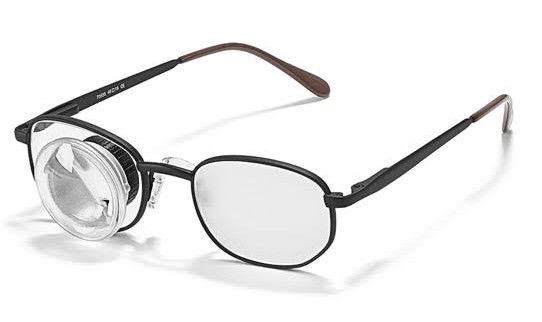
There is a wide range of optical solutions for reading. When the visual impairment is not severe, both eyes can be shared and glasses up to 16+ diopters can be given to create retinal magnification. Thanks to the special structure of the glasses, despite the high prescription, the eyes manage to perform the operation with minimal fatigue of the visual system.

The Patriot ViewPoint is one of the world's most innovative and leading solutions for people with moderate to severe vision loss, who are dealing with retinal diseases such as:
Macular degeneration (AMD), diabetic retinopathy, glaucoma and other retinal injuries.
The device offers digital magnification of up to 22x, a sharp display and a wide field of view, enabling high-quality and meaningful vision even for people with severe visual impairment.
It is ideal for watching TV, reading, working at the computer, live performances, movies, football games and watching nature – and restores the ability to enjoy visual content.

Low vision filters are special coatings that reduce and sometimes completely eliminate the transmission of blue light. The filters improve vision in two ways:
Increasing contrast = contrast that allows you to see details more sharply, read and distinguish things around you better.
